Color Link - Connect the Dots
- 4.8
- Rating
- 5.00M
- Installs
- Free
- Price

 Analysis by App-foxy
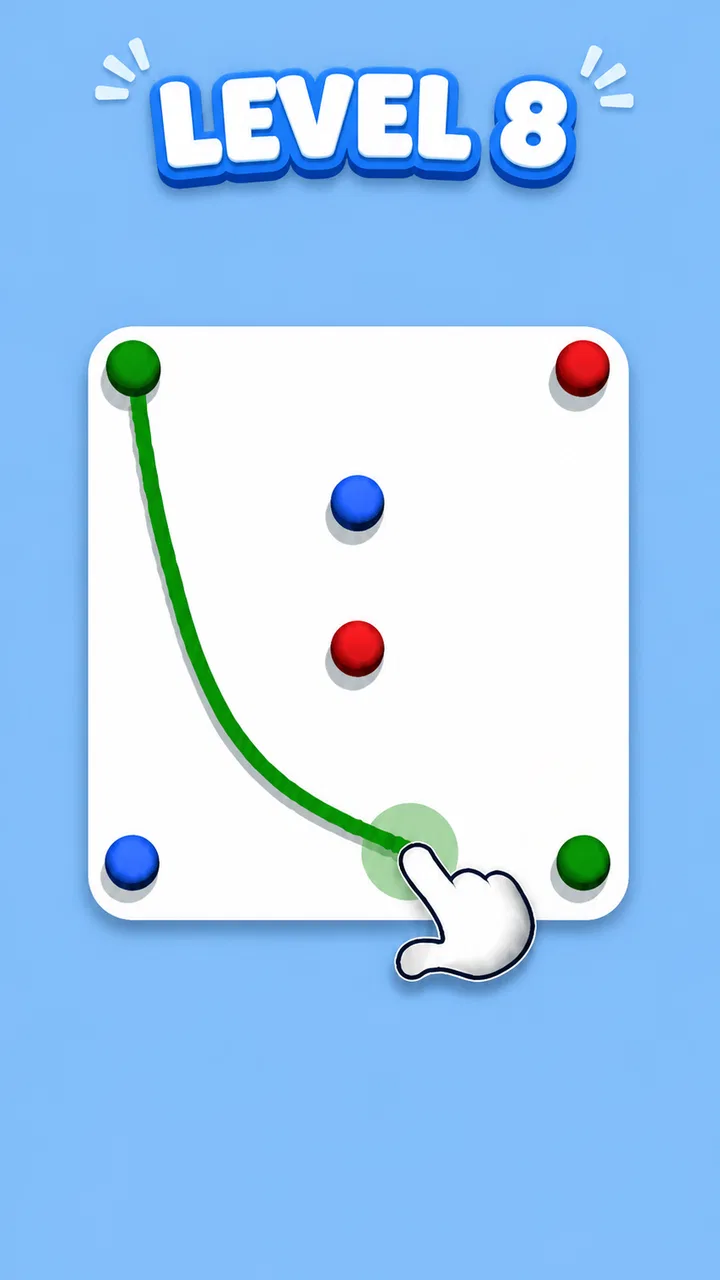
I went into Color Link - Connect the Dots expecting a lightweight matching game, and that is exactly what it is: a simple casual puzzle built around connecting matching colors. Its appeal is not a complicated story or a huge collection of systems. Instead, it offers a clean mental break that is easy to understand within seconds and comfortable to play in short sessions.
My overall view is positive, with one important qualification. This is best treated as a calm, gradually demanding pastime rather than a game you play for deep strategy or constant novelty. The free entry point, Everyone age rating, and low learning curve make it approachable, while the high average rating of 4.8 from roughly 115 thousand ratings suggests that its straightforward format has found a receptive audience. I can see why it has passed one million installs.
Why the simple concept works so well
The central idea is immediately readable: connect dots or matching colors without making the board feel chaotic. That clarity matters on a phone. I never need to remember a complicated control scheme, study a long tutorial, or build a character before enjoying a round. The game communicates its purpose through the board itself, which makes it suitable for a quick session when I have only a few minutes.
You May Also Like

 Google Keep - Notes and lists
Google Keep’s Quiet Growth Shows the Appeal of Simpler Notes
As mobile work gets busier, Google Keep keeps winning a simple contest: capture a thought quickly, find it later, and get on with the day.

 Blood Strike: 2.5 Anniversary
Blood Strike’s Loadouts Turn Every Drop Into a Tactical Gamble
A close look at Blood Strike’s custom loadouts: how fast access to signature weapons reshapes its battle royale rhythm, rewards preparation, and narrows the gap between fights.

 Pandora - Music & Podcasts
Pandora’s Music Is Easy to Start, but Harder to Recover
Pandora’s strength is its low-effort path from a seed to a station. Its weak spot is how much confidence it asks you to place in connection, setup, and quiet recovery.

 8 Ball Pool
 Is Built on Rivalries, Rematches, and Routine
A close look at the rivalries, rematches, shared routines, and unanswered safety questions that turn a quick pool match into a persistent mobile community.

 Samsung Music
’s Quiet Strength Is Playing What You Already Own
Its reach comes less from spectacle than from dependable access to a personal library. That simplicity is both the app’s strongest retention engine and its ceiling.

 AccuWeather: Weather Radar
AccuWeather Review: A Quick, Clear Forecast for Everyday Decisions
For everyday plans, the best forecast is the one you can understand quickly. AccuWeather makes rain timing, radar, and local conditions easy to act on, with a few trade-offs.
More From Our News Desk



What makes this kind of puzzle satisfying is the gradual shift from obvious moves to careful planning. At first, I can usually spot a useful connection quickly. As the arrangement becomes less forgiving, every line matters more because one careless path can reduce the space available for another color. That creates a small but meaningful trade-off: finishing one pair immediately may be less useful than preserving room for several pairs later.
I especially like that the game can occupy different attention levels. I can play it casually while waiting for an appointment, or I can give a board my full attention when I want a more deliberate challenge. That flexibility is more valuable than it sounds. Many casual games demand constant reactions, but a color-linking puzzle lets me pause mentally, inspect the layout, and choose a route at my own pace.
The strongest part of the design is its accessibility. The store summary, “Connect the Dots!”, describes the experience in a very direct way, while the short description, “Color Link,” keeps the premise equally clear. There is no need to understand a fictional world or a complicated objective. For children, older players, and anyone who prefers visual rules over text-heavy instructions, that is a genuine advantage.
A useful game for small pockets of time
A realistic use case is a short commute or a few minutes before dinner. I can open the game, solve a small number of boards, and stop without feeling that I have abandoned a long-running task. That makes it less demanding than many competitive mobile games, where stopping midway can mean losing progress or missing a timed opportunity.
It also works well as a reset between more demanding activities. After a long stretch of reading or work, following colored paths gives my attention something concrete to do without requiring the emotional investment of a story-driven game. The visual focus can feel pleasantly absorbing, particularly when I am looking for a quiet alternative to endless scrolling.
Another practical strength is that the rules are easy to explain to someone else. If a friend or family member asks what I am playing, I can demonstrate the basic idea immediately. That makes it more approachable than puzzle games whose enjoyment depends on learning a specialized vocabulary or understanding a complex scoring system.
Where the challenge comes from
The challenge is not based on fast reflexes. It comes from spatial judgment and the order in which I make decisions. A route that looks efficient may block another connection, so I have to think beyond the first successful move. This gives the game more substance than a purely automatic color-matching activity.
My most useful habit is to inspect the tightest areas first. If two colors appear to have only a narrow route available, I treat that route as a priority and leave more flexible connections for later. I also avoid drawing the first obvious path immediately when it crosses a central part of the board. Preserving open space often matters more than completing a pair quickly.
That small change in approach turns the game from random tapping into a repeatable puzzle process. I look for bottlenecks, compare possible routes, and consider whether a connection will divide the remaining space awkwardly. These observations are not advertised as advanced strategy, but they are what make the experience more rewarding once the basic controls become familiar.
A second useful tip is to work from the edges inward when the layout allows it. Edge connections often have fewer alternatives, while central paths can remain flexible for longer. This is not a universal rule, and forcing it can be counterproductive, but it gives me a helpful starting point when the board initially looks busy.
The main weakness: simplicity can become repetition
The same clarity that makes the game welcoming can also limit its long-term appeal. Once I understand the basic solving pattern, the experience depends heavily on how much variety the individual boards provide. Players who want new mechanics, a strong narrative, competitive events, or a sense of constant progression may find the format too narrow.
This is not a flaw for everyone. A focused puzzle can be more relaxing precisely because it does not keep adding distractions. However, I would not recommend it as the only game on a phone for someone who needs frequent surprises. If your favorite casual titles regularly introduce new characters, changing objectives, or social competition, this one may feel restrained by comparison.
There is also a difference between a game being easy to learn and being endlessly interesting. Color Link succeeds strongly at the first goal. Its staying power depends on whether you enjoy refining your solving habits and chasing the satisfaction of a clean board. If that loop feels repetitive after several sessions, there may not be enough variety to pull you back.
The presence of optional in-app purchases is another point worth considering. The game is free to download, but individual purchases range from $2.99 to $19.99. That does not automatically make the payment model bad, yet I would approach any optional purchase carefully and decide first whether the free experience already gives me enough enjoyment. For a simple casual title, spending should feel like a deliberate choice rather than something necessary to test whether the game is worthwhile.
For parents, the Everyone rating makes the game broadly approachable, but I would still treat purchases as a separate consideration. The age label describes the content, not a family’s preferred spending rules. If a child uses the device, checking the device’s purchase controls is sensible, especially because the game is free to start.
How it compares with other casual puzzle choices
Compared with match-three games, this is a more spatial and less reaction-oriented experience. Match-three alternatives usually emphasize quick combinations, cascading effects, and frequent visual rewards. Color Link asks me to think about paths and available space instead. I prefer it when I want a quieter puzzle where planning matters more than speed.
Compared with word games, it has a lower language barrier. I do not need a large vocabulary or comfort with a particular language to understand the objective. That makes it a better choice for shared devices or mixed-age households where a visual puzzle is easier for everyone to pick up.
Compared with physics puzzles, it is more predictable. Physics-based games often create memorable surprises when objects behave unexpectedly, while this format is built around reading a board and making controlled decisions. Players who enjoy precision and order may appreciate that consistency; players who want experimentation may prefer a physics-focused alternative.
It also differs from competitive puzzle games because the appeal is primarily personal. I can focus on solving the current arrangement rather than worrying about another player’s speed or ranking. That makes it a good fit for people who dislike pressure, but a weaker choice for anyone who needs leaderboards or direct competition to stay motivated.
Who should install it
I would recommend this game to someone who wants a free, approachable casual title for short breaks. It is particularly suitable for players who enjoy visual logic, prefer simple controls, and like improving through observation rather than memorizing complicated rules. It can also be a comfortable introduction to mobile puzzle games for someone who does not usually play games.
It is a sensible option for a family tablet because the premise is easy to explain and the content rating is Everyone. I would also suggest it to adults who want something more mentally engaging than passive scrolling but less intense than an action game. The ability to start quickly and stop naturally is one of its most practical qualities.
I would skip it if you are looking for a rich story, character development, online competition, or a large strategic system. I would also hesitate to recommend it to players who become bored with repeated board-solving patterns. In those cases, a broader puzzle collection or a game with several distinct modes would probably offer better long-term value.
Device compatibility is fairly accessible for a modern phone: the current version is 3.03 and it requires Android 8.0 or later. That makes it relevant to many Android users, although anyone with an older device should check the operating-system requirement before trying to install it. The developer behind it is Happy Games Co., Ltd., and the game has been available since August 27, 2022.
My final assessment after playing
My recommendation comes down to expectations. Color Link is strongest when used as a focused, low-pressure puzzle rather than an all-purpose mobile game. Its rules are clear, its visual premise is accessible, and its path-based decisions provide enough thought to keep a simple board from feeling completely empty.
I appreciate the way it fits into ordinary routines. I can use it for a short mental pause, return to it without relearning anything, and leave without the sense that I have missed a major event. That convenience is a real strength, especially for players who want a game that respects small amounts of free time.
At the same time, I would not overlook the limits of the formula. The experience may lose its freshness for players who need constant novelty, and the optional purchase range means I would keep spending under control until I knew how much I actually played. Those are manageable concerns, but they are part of an honest recommendation.
For me, the game earns its place as a dependable casual puzzle because it does one thing clearly and gives that idea enough room to become satisfying. If connecting colored paths sounds more appealing than racing a clock, building a collection, or competing against strangers, this is an easy game to try. If you need a deep progression system or a stream of new mechanics, I would choose a broader alternative instead.
In short, I see it as a friendly, accessible time-filler with a modest but genuine strategic layer. The free starting point, Everyone rating, and strong reception make it easy to consider, while the focused design tells me exactly what kind of player will enjoy it most. Choose it for calm visual problem-solving, not for endless content or high-intensity action.
FAQs for Color Link - Connect the Dots
01What is Color Link - Connect the Dots, and how does it work?
Color Link - Connect the Dots is a puzzle game where players connect matching colored dots with pipes to cover the entire board. It challenges your strategic thinking and problem-solving skills as you navigate through increasingly complex levels without crossing any lines. The goal is to complete the connection of colors as efficiently as possible.
02Is Color Link - Connect the Dots free to play?
Yes, Color Link - Connect the Dots is free to play. However, it does offer in-app purchases that can enhance the gaming experience. These may include hints, additional levels, or ad-free gameplay. While the base game is accessible without spending money, these purchases can provide added convenience and enjoyment.
03What devices are compatible with Color Link - Connect the Dots?
Color Link - Connect the Dots is available on both Android and iOS devices. It supports a wide range of smartphones and tablets, ensuring you can enjoy the game whether you're using an Android device like a Samsung Galaxy or an Apple device such as an iPhone or iPad. Check the app store for specific device requirements.
04Are there different difficulty levels in Color Link - Connect the Dots?
Yes, Color Link - Connect the Dots features multiple difficulty levels to cater to a variety of players, from beginners to advanced puzzle solvers. As you progress, the puzzles become more challenging, requiring greater focus and strategy. This diversity keeps the game engaging and allows players to improve their skills over time.
05How can I get help if I’m stuck on a level in Color Link - Connect the Dots?
If you find yourself stuck on a level in Color Link - Connect the Dots, the game offers hints that you can use to guide you. These hints can be accessed through in-app purchases or sometimes earned through gameplay. Additionally, online communities and forums may offer tips and strategies for particularly challenging puzzles.
Pros
- Intuitive interface for easy navigation.
- Vibrant colors enhance visual appeal.
- Challenging levels keep users engaged.
- Minimal ads for uninterrupted play.
- Offline mode available for on-the-go fun.
Cons
- Limited levels in free version.
- No multiplayer or social features.
- Occasional lag on older devices.
- In-app purchases can be pricey.
- Lacks customization options.

Color Link - Connect the Dots
Gallery